
How to Search Criminal Dockets
Begin with the free Colorado Judicial Branch Docket Search for Rio Grande County when the goal is a scheduled criminal hearing. It lists calendar events, not every filing. Set the location to Rio Grande County, pick District or County Court. Then add a case number, party, attorney, court type, or division beside a date or date range. One filter beyond the date is required for the search to run.
A full Rio Grande County criminal docket search usually takes more than one channel. The public calendar gives settings. A Judicial Branch-designated commercial vendor sells a real-time Register of Actions. It works under its own terms and fees. The Clerk of Court can issue an official ROA or a named document. Ask through the web request form, by contacting the court, or at the combined-court counter. Approved parties who opt into their own case may use Colorado Courts E-Filing. CCE is not an open public viewer, though.
- Identify Rio Grande District Court, Rio Grande County Court, or a municipal court from the caption or filing papers.
- Search the official calendar with the year, case class, and sequence when the number is known.
- Match the full case number, hearing type, location, appearance type, and courtroom.
- Use the ROA route when the filing history or recorded disposition is needed.
- Request the complaint, information, order, or certified disposition from the filing court.
Rio Grande County Criminal Docket Search
The state Docket Search interface separates its controls. There is a four-digit year, a case class, and a sequence number. You can also search an individual, a business, an attorney name, or a bar number. Date ranges run from six months and three months down to one month, one week, today, or a specific date. Results may span several pages and can be printed or exported.
The manifest image shows the official search screen. Its filters explain why a broad date-only query will not run.
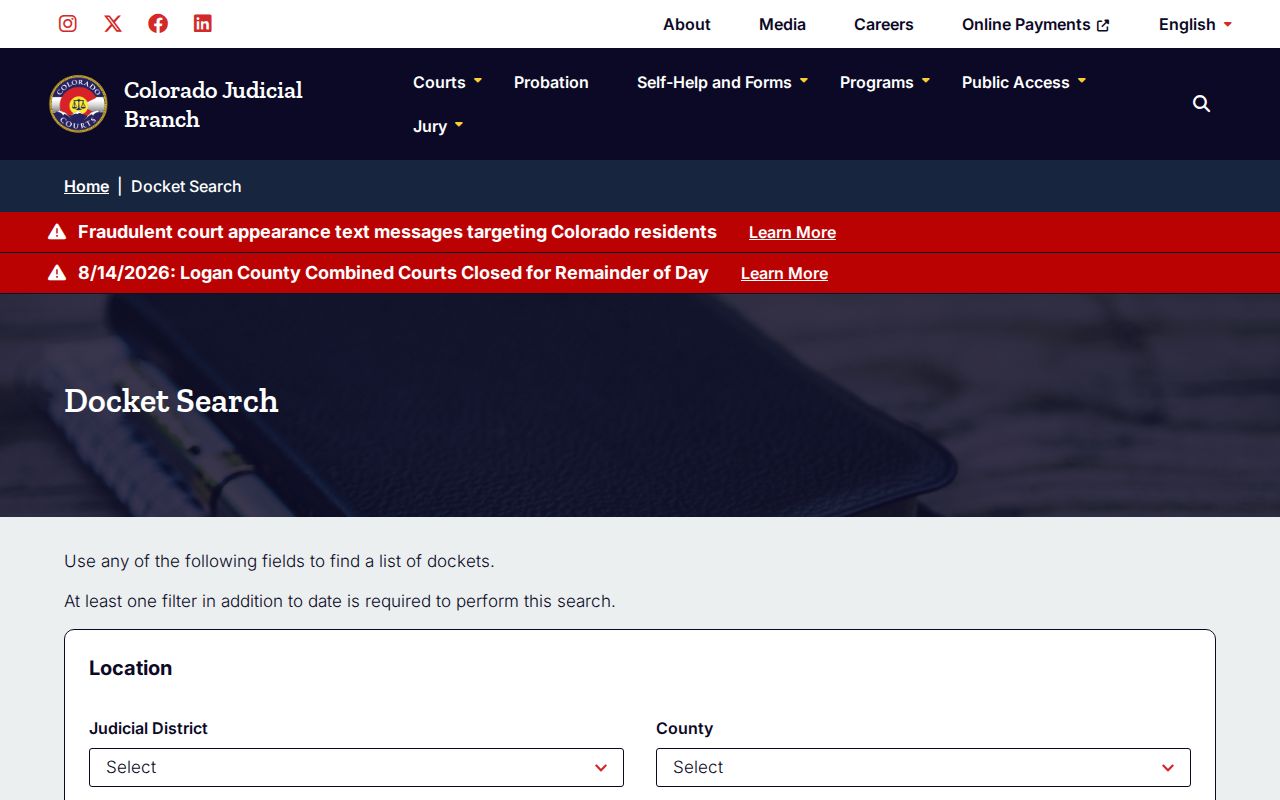
What the image makes clear is scope. The Rio Grande County criminal docket there is the public hearing calendar, not a full Register of Actions and not a document viewer.
What a Criminal Docket Shows
The calendar is honest about its limits. It shows the scheduled date, start time, estimated duration, public caption representation, case number, hearing type, location, appearance type, and courtroom. That is all it shows. Charge history, pleas, bond terms, attorney history, the financial ledger, disposition details, and document images live in the ROA or the filed record, when access rules permit.
| Case number | Year, class, and sequence, such as 2026CR123 or 2026M123. |
|---|---|
| Calendar event | Date, time, duration, hearing type, location, appearance type, and courtroom. |
| ROA activity | Chronological filings, minute orders, settings, resets, pleas, and recorded outcomes available under access rules. |
| Filed document | The actual complaint, information, motion, order, or Disposition/Sentence Order requested from the clerk. |
| Transcript | A separate record of spoken proceedings ordered through the district transcript process. |
Never read a calendar label as proof of an outcome. A “Sentencing Hearing” entry only means a setting was placed on the calendar. The signed order and the ROA establish what the court actually recorded.
Rio Grande County Criminal Docket Classes
Case-class letters are the fastest local clue to venue. A CR file sits in the District Court criminal docket. An M file marks a County Court misdemeanor. T and some R matters may involve traffic or limited proceedings. JD is juvenile delinquency. That class follows special access rules. Always take the class from the number or the portal selection, never from a guess based on a name.
- CR
- District Court felony prosecution.
- M
- County Court misdemeanor case.
- T
- County Court traffic case.
- JD
- Juvenile delinquency matter with restricted access.
So Rio Grande County criminal court dockets can carry two trial-court levels through one shared clerk counter. Municipal ordinance and city-filed traffic matters stay with the municipal clerk unless a lawful transfer or appeal moves them.
Stages on a Criminal Docket
A criminal docket grows as a chain of accepted filings and court events. Early labels include Hearing on Advisement, First Hearing, Return Filing of Charges, Arraignment, or Appearance of Counsel. Later entries may add a Status Conference, PreTrial Conference, Motions Hearing, trial setting, Disposition Hearing, Sentencing Hearing, or Hearing on Probation. The exact sequence differs by case and court.
Docket flow: Filing › Arraignment › Pretrial › Plea or Trial › Disposition › Sentencing
A continuance request does not erase the duty to appear. Only a court order changes the setting. When the Rio Grande County criminal docket shows both an old setting and a later reset, recheck the current calendar and the newest order.
Rio Grande County Criminal Docket Venues
A felony complaint can begin on the County Court side for an advisement or preliminary event. A District Court CR case then moves ahead. That route leaves hearings tied to different class identifiers. Misdemeanors stay within County Court jurisdiction, while District Court holds felony prosecutions after filing or bind-over. Juvenile delinquency uses its own JD class. It is not treated as an ordinary public criminal search.
| Rio Grande court | Criminal docket slice | Search clue |
|---|---|---|
| District Court | Felony prosecutions | CR case class |
| County Court | Misdemeanors, traffic, early felony matters | M, T, R, or early complaint setting |
| Municipal Court | City-code and locally filed traffic cases | Issuing court on citation or notice |
Rio Grande County Criminal Docket Outcomes
A hearing title is not a disposition record. “Probation Review” does not prove probation was revoked. “Sentencing Hearing” does not prove a conviction or reveal the sentence. A missed-hearing listing does not establish bond forfeiture, either. Verify each outcome through the ROA and the order recording what occurred.
For exact language, use the Judicial Branch Record/Document Request Form. Choose Rio Grande County. Give the case number or party, filing year, case type, and other identifying facts. Then request the Complaint/Information, Disposition/Sentence Order, ROA, or another named item. The web form states a usual response within three business days absent extenuating circumstances.
Which Court Holds Criminal Dockets
Two different offices serve Rio Grande County, and only one holds criminal case files. The Clerk of Court at Rio Grande Combined Court keeps the District Court and County Court dockets. Those files include pleadings, orders, and ROAs. A second office exists. It is the elected Rio Grande County Clerk and Recorder, and it runs elections, recording, and motor-vehicle work, not criminal court records. For the official layout, use the Rio Grande County judges and staff directory. It lays out this public court structure for the county.
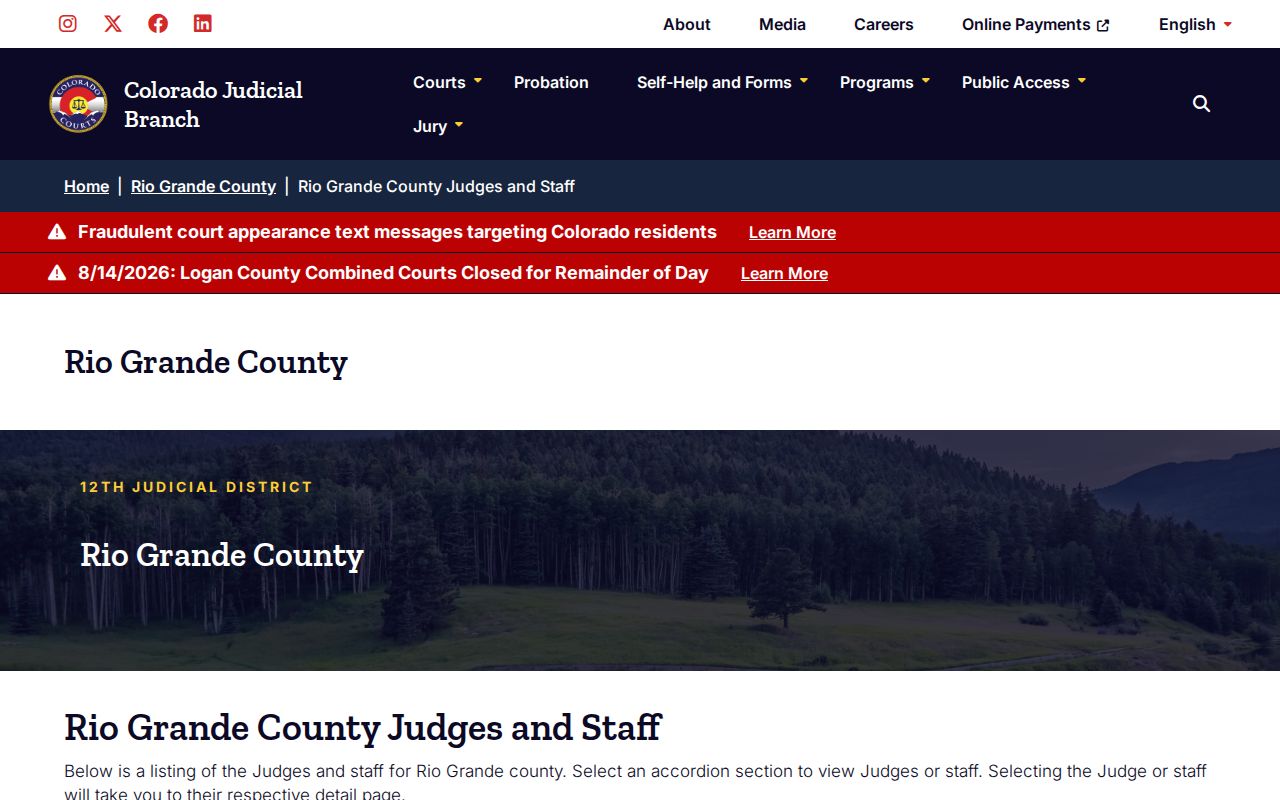
Use that directory to send a Rio Grande County criminal docket question to the Judicial Department. A county administrative office cannot answer it.
Rio Grande County Criminal Docket Access
Work through access in order. Start with the calendar, then an ROA or clerk name search, then a record request, then direct contact. The Clerk of Court takes in-person requests at Rio Grande Combined Court. The address is 925 6th Street, Room 204, Del Norte, Colorado 81132. Hours are weekdays, 8:00 a.m. to 4:00 p.m. You can also call 719-657-3394 or write to RioGrandeClerk@judicial.state.co.us. Phone and mail work well when you need help routing a request. A nonparty name search that includes an ROA is listed at $5. Records stored off-site may add actual retrieval cost. Ask the clerk whether you need a plain, certified, or exemplified copy, because each is a distinct product. Note: Call before you travel. Archived retrieval, protected access, or same-day certification could affect your Rio Grande County criminal docket request.
Rio Grande County Criminal Docket Transcripts
A transcript records the words spoken in court. It is not the ROA. The 12th Judicial District does not ordinarily duplicate audio, apart from exceptions stated in its policy. Requests go through JDF 4 and the district transcript coordinator. Ordinary delivery targets 30 days at $3.60 per page. Expedited service targets 10 days at $4.35 per page. Choose the transcript route when the spoken record matters. For the chronological Rio Grande County criminal docket, a filed motion, or a signed sentence order, the clerk route is the right one. A Transcript of Judgment is a separate civil clerk product and does not reproduce courtroom speech.
Rio Grande County Criminal Docket Probation
The local Rio Grande County probation page is its own Judicial Branch service. It does not replace the court docket or prove the result of a review hearing.
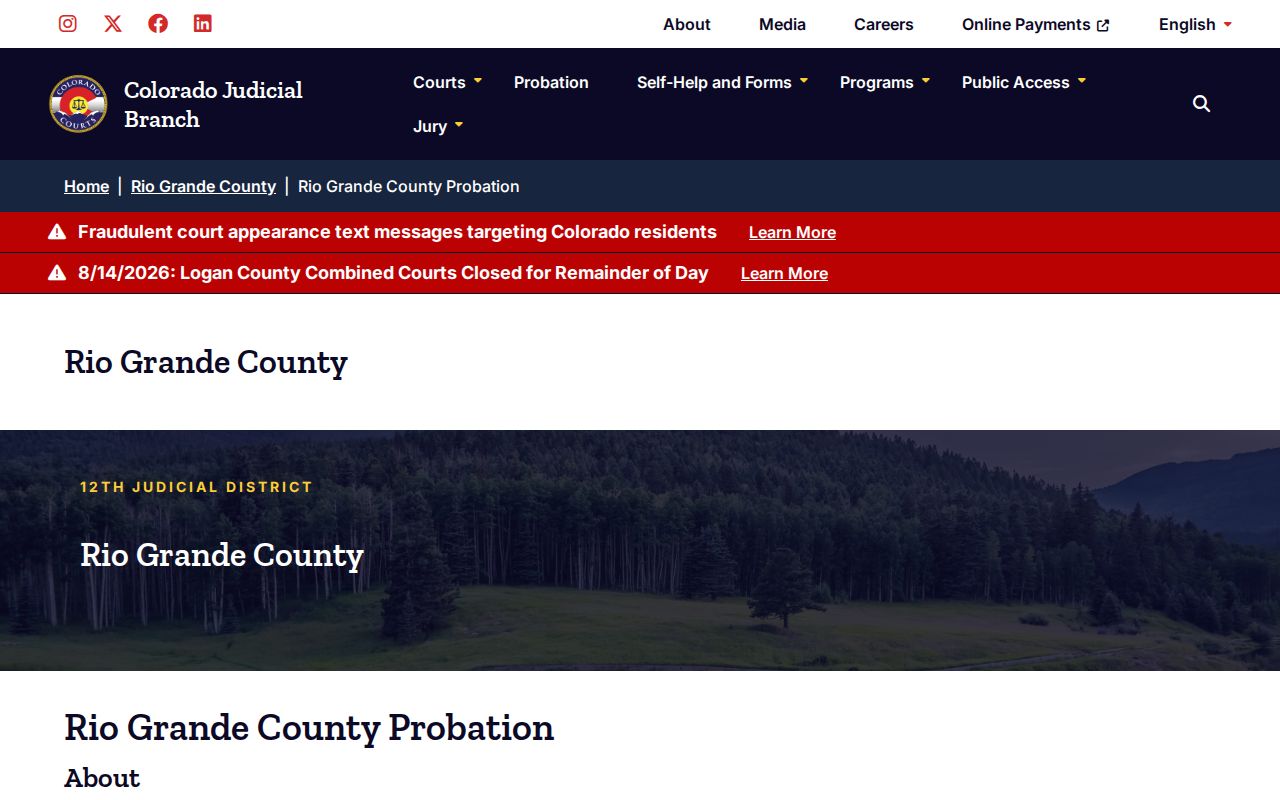
Probation services and the clerk-held Rio Grande County criminal docket stay separate. Court orders and the ROA remain the real sources for case outcomes.
Rio Grande County Drug Court Dockets
The regional problem-solving program here is the 12th Judicial District Adult Drug Court. It serves a six-county district. So it is not a separate Rio Grande municipal docket. Search any public courtroom activity under the underlying criminal case number. Access limits still apply. Do not assume treatment or clinical details are public. A hearing appearing changes nothing. The CR number remains the key to public case activity. The program name describes a supervised court model. The court posts no separate Rio Grande County criminal docket calendar, local eligibility list, or public program duration.
Public Access and Sealed Criminal Dockets
Remote access and courthouse access are not the same thing. Colorado security levels run from Public, Protected, and Restricted to Suppressed and Sealed. Protected material may require redaction. Restricted or suppressed files admit only defined users. Sealed files have no ordinary public access. Juvenile records follow special state rules. A missing calendar result can also mean no current hearing, a wrong venue, an old file, or weak search terms. So absence alone proves nothing.
Key access rules:
Chief Justice Directive 05-01 governs public access to Colorado court records by security class, law, rule, and court order.
C.R.S. §§ 24-72-304 and 24-72-305 allow reasonable inspection rules and recognize lawful grounds to deny criminal justice record access.
C.R.S. § 19-1-304 sets special confidentiality and disclosure rules for juvenile records.
For a public Rio Grande County criminal docket, start with the least intrusive source that answers your question. A current hearing date may need only the calendar. The full history, filed charge, or certified outcome belongs with the ROA and the clerk's request channels.